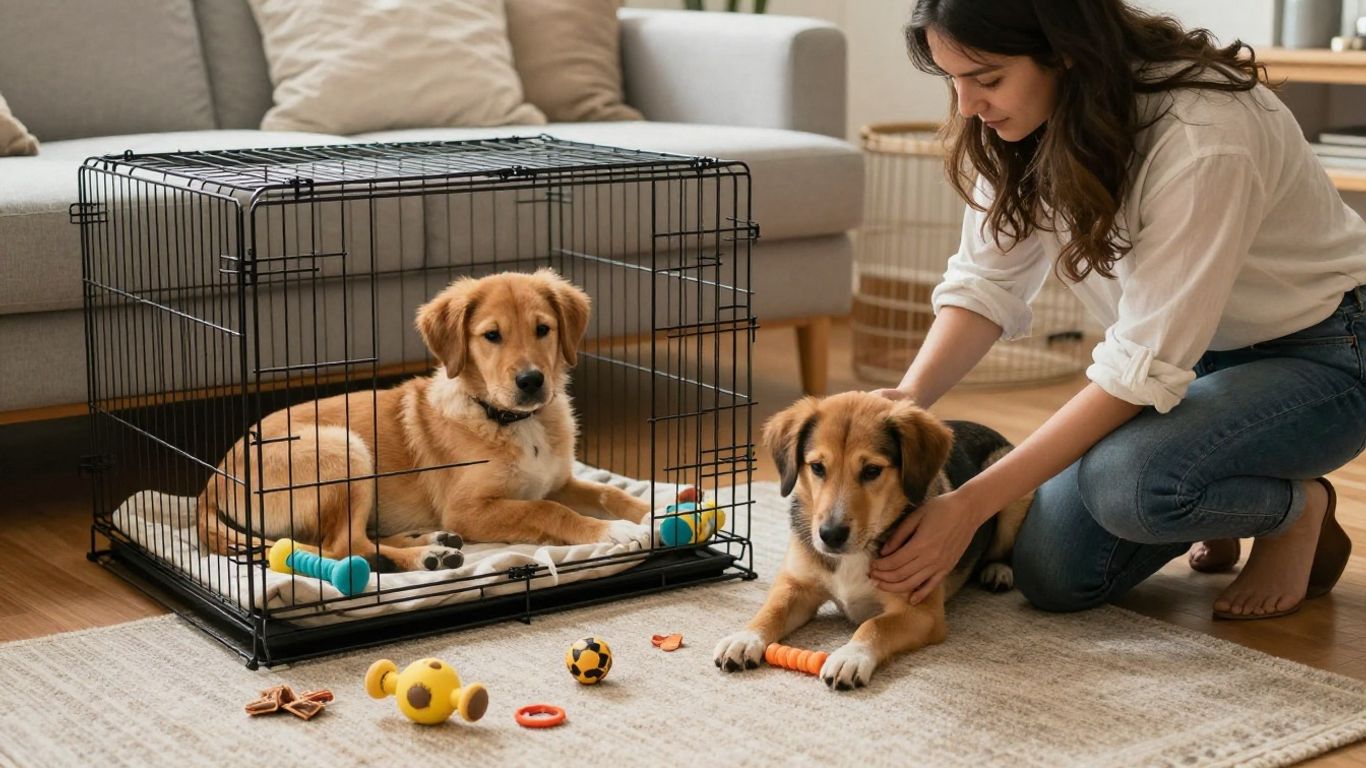
Choose the right crate and create a welcoming setup
A crate should feel like a quiet resting place, not a cage you use when your dog has done something wrong. Before you begin training, set up the space so your dog can stand, turn around, lie down and stretch comfortably. A thoughtful arrangement makes the first few sessions easier for both of you. Think of the crate as part of your dog’s routine, rather than a shortcut for managing every difficult moment.
Select the correct crate size
Choose a crate that gives your dog enough room to stand without crouching, turn around easily and lie down in a natural position. It should not be so large that your dog can sleep at one end and use the other end as a toilet. If you are preparing for a growing puppy, a crate with an adjustable divider can help you increase the available space over time.
Measure your dog from the floor to the top of the head, and from the nose to the base of the tail. Allow a little extra room for comfortable movement, but avoid choosing a crate several sizes too large. Recheck the fit as your puppy grows, because a crate that suited a young dog may soon become restrictive.
Add comfortable, safe bedding
Use bedding that is comfortable but suitable for your individual dog. Some dogs settle well on a washable mat, while others may chew or pull apart soft fabrics. Start with something simple and observe what your dog does when left to relax.
Safety comes before softness. Remove bedding that is being shredded or swallowed, and avoid anything with loose cords, broken pieces or filling that your dog can reach. Keep the crate clean, particularly while you are working on toilet training, and wash bedding regularly.
Position the crate in the right part of your home
Place the crate somewhere your dog can be near you without being in the busiest path of the household. A family room can work well during the day because your dog can rest while still seeing and hearing you. Avoid draughts, strong direct sun, heaters and places where doors or people constantly pass close by.
Your dog may need different locations at different times. You might keep the crate in a shared room during the day and move it closer to your bedroom at night, especially when a puppy is still settling. Wherever it goes, make sure the door can open safely and that your dog cannot pull nearby objects through the bars.
Introduce toys and positive associations
Choose a few sturdy toys that are appropriate for your dog’s size and chewing habits. You can offer a safe food toy, a chew or a favourite soft toy if your dog does not destroy it. Keep the selection small so the crate remains uncluttered and easy to clean.
Scatter a few treats near the entrance at first, then place them just inside when your dog is relaxed. You are building a pattern: entering the crate brings pleasant things, and leaving is not a dramatic event. Let your dog investigate at their own pace rather than lifting them in to speed up the process.
Help your dog feel comfortable in the crate
The first goal is not to close the door. It is to help your dog choose the crate willingly and feel safe there. Keep early sessions quiet, brief and easy to repeat. If your dog walks out, that is useful information, not a failure.
Start with the door open
Secure the door so it cannot swing unexpectedly, then leave it open while your dog explores. Drop a treat near the entrance and allow your dog to decide whether to step inside. You can sit nearby and carry on with a calm activity, making the crate part of ordinary household life.
When your dog enters, wait before offering another cue. Let them sniff, turn around and leave if they wish. Repeating these low-pressure visits helps the space become familiar before you ask for stillness or a closed door.
Use treats, meals, and praise
Food can make the crate appealing, especially when your dog is already relaxed. Begin by placing treats at the entrance, then gradually move them farther in. If your dog is comfortable, offer meals beside the crate and later inside it, with the door remaining open.
Use a calm voice and praise the behaviour you want, such as walking in, lying down or remaining settled. Keep your response measured rather than exciting. The aim is for the crate to feel like an ordinary place where good things happen, not a stage where your dog must perform.
Read your dog’s body language
Your dog’s body language tells you whether the training is moving at a comfortable pace. A loose body, soft eyes, normal breathing and willingness to take food usually suggest that the situation feels manageable. A tucked tail, pinned ears, frantic movement, lip licking or refusal of familiar treats may mean you have asked for too much.
Watch for patterns rather than one isolated signal. A dog may yawn because they are tired, while repeated attempts to escape or persistent panting deserve more attention. If your dog looks worried, open the door, create distance and return to an easier step next time.
Avoid forcing your dog inside
Pushing, dragging or placing your dog into the crate can make the space feel threatening. It may also teach your dog to avoid your hands or retreat before you can guide them. Even if you need to manage your dog briefly for safety, keep that separate from the patient process of crate training.
Instead, use food, positioning and repetition to invite your dog in. Reward small steps, including looking at the crate or placing one paw inside. Progress may seem slow, but voluntary behaviour is more likely to become a dependable habit.
Build up crate time step by step
Once your dog is entering comfortably, you can begin adding the parts that often cause difficulty: a closed door, your movement and short periods alone. Change only one factor at a time when possible. If your dog struggles, make the next attempt easier rather than insisting on the same duration.
Begin with brief door closures
Wait until your dog is relaxed inside before moving the door a small amount. Close it for a moment, then open it while your dog is still calm. Repeat several times, varying the length slightly without turning every release into a major event.
If your dog immediately paws at the door or becomes distressed, the step was too difficult. Go back to touching or partly closing the door, then reward calm behaviour. A short successful repetition is more useful than a long session that ends in panic.
Increase distance and duration gradually
After your dog can manage brief closures, add small amounts of time and distance. You might sit beside the crate, move to another chair, walk across the room and then briefly step out of sight. Return to an easier version if your dog begins to worry.
A simple progression can help you avoid rushing the process:
- Close the door while you remain beside the crate.
- Stand up and sit down without leaving the room.
- Walk away for a few steps and return.
- Step briefly out of sight, then come back calmly.
This sequence is a guide, not a test that must be completed in one day. Repeat the level your dog can handle comfortably before moving on, and keep some easy repetitions in the routine.
Practice while you are still at home
Your dog should learn that the crate is not only used when you leave. Ask your dog to settle inside while you read, prepare food or work nearby, provided the environment remains safe. This separates crate time from the sudden change that happens when you pick up keys and walk out.
Keep sessions realistic and give your dog breaks. You are teaching relaxation, not asking your dog to stay confined for as long as possible. Exercise, play, social contact and opportunities to move freely all remain part of a balanced day.
Return calmly after short absences
When your dog can settle while you move around the house, practise very short departures. Leave without a long farewell, then return before your dog becomes distressed. Come in quietly and wait for a calm moment before opening the crate.
A calm return helps keep departures and arrivals ordinary. If your dog is barking, scratching or showing signs of panic, do not simply make the absence longer. Shorten it and rebuild more slowly, because distress is a sign that the training needs adjusting.
Combine crate training with potty training
A crate can support toilet training because it limits unsupervised wandering for short periods, but it cannot replace regular trips outside. Puppies have limited bladder control, and every dog has individual needs. Plan around your dog’s age, routine, meals, sleep and activity rather than expecting the crate to solve accidents by itself.
Create a consistent daily schedule
Take your dog outside at predictable points in the day, then offer rest, play and meals in a familiar rhythm. A routine makes it easier for you to notice patterns and prevents your dog from spending too long in the crate simply because the day became busy.
A useful schedule may include:
- A toilet trip after waking.
- A trip after meals and active play.
- A break after a nap.
- A final outing before bedtime.
Keep the schedule flexible enough for your particular dog. As your dog becomes more reliable, you can gradually adjust the timing while continuing to watch for signs that a break is needed.
Take puppies outside at the right times
Puppies commonly need to go out after sleeping, eating, drinking, playing and exciting interactions. Carry or guide your puppy promptly to the chosen toilet area, then wait quietly. When your puppy finishes, offer gentle praise straight away so the connection is clear.
Do not expect a young puppy to cope with long stretches in a crate. If you will be away, arrange a suitable break or a safe alternative area. The crate should help your puppy rest between outings, not become a substitute for supervision and regular access to the outdoors.
Recognize signs that your dog needs a bathroom break
Your dog may sniff the floor, circle, pace, whine, move towards the door or suddenly stop playing. Puppies can show signs only briefly, so respond promptly when you notice a change in behaviour. Keeping a simple note of meals, sleep and successful outings can help you spot your dog’s usual pattern.
Some dogs give subtle signals, particularly after moving into a new home. Watch closely during the first weeks and take your dog out before accidents are likely. With repetition, your dog may begin to approach the door or use the signal you have encouraged.
Handle accidents without punishment
Accidents are part of the learning process, especially for puppies and dogs adjusting to a new routine. If you catch your dog in the act, interrupt gently and take them outside. If you find the mess later, clean it thoroughly and carry on without scolding.
Punishment can make your dog nervous about toileting near you, which may make training harder. Review the routine instead: perhaps the last break was too long ago, the crate was too large or your dog had been playing and needed to go sooner. A practical adjustment is usually more helpful than a reprimand.
Prevent common crate training problems
Problems usually become easier to solve when you look at what happened immediately before them. Your dog may be tired, under-exercised, overexcited, lonely, uncomfortable or simply progressing too quickly. Treat barking or resistance as information about the plan, not as stubbornness that must be defeated.
Respond to whining and barking
First check the basics. Your dog may need the toilet, water, a temperature change, a break or a quieter location. If those needs are met and the noise is mild, wait for a brief pause before calmly rewarding quiet or releasing your dog when appropriate.
Avoid opening the door at the peak of frantic noise if you can do so safely, because your dog may learn that louder behaviour makes the door open. However, do not leave a dog in escalating distress just to wait for silence. Make the next session shorter and easier, and seek qualified help if the problem continues.
Manage separation anxiety and distress
Some dogs become deeply distressed when separated, and crate training alone may not address that feeling. Signs can include frantic escape attempts, heavy panting, drooling, persistent pacing or self-injury. These are not ordinary complaints to ignore.
A safe training plan builds confidence without asking your dog to endure fear.
If your dog shows severe distress, stop increasing the absence and use a safe arrangement that prevents harm. A qualified force-free trainer or veterinary behaviour professional can help you assess the situation and create a suitable plan.
Avoid using the crate as punishment
If the crate appears after every scolding, your dog may begin to associate it with isolation and unpleasantness. Use another calm management method when you need to interrupt behaviour, then keep the crate available as a neutral resting place.
You can still guide your dog into the crate when you need a safe pause, such as while visitors arrive or a tradesperson enters, but prepare for these moments in advance. Offer something appropriate to occupy your dog and keep the duration reasonable. The aim is safety and relaxation, not retaliation.
Know when to pause and adjust the plan
Pause when your dog repeatedly refuses food, cannot settle, tries to escape or shows a new fear response. Look at the whole picture, including the crate’s location, bedding, noise, duration and what happened before the session. Sometimes moving the crate or reducing the time inside makes an immediate difference.
Keep a note of what you tried and how your dog responded. This can reveal whether the difficulty happens only at night, only when you leave or after particular activities. If your dog’s distress is intense or worsening, ask a suitably qualified professional for individual guidance.
Adapt crate training for different dogs and situations
There is no single timetable that suits every dog. A confident puppy may settle quickly, while an adult rescue dog may need time to understand that the crate is safe. Your dog’s history, temperament, health, routine and previous experiences all matter. Adjust the plan without treating slower progress as a failure.
Adjust the approach for puppies
Puppies need frequent toilet breaks, plenty of sleep and gradual exposure to being alone. Keep sessions short and schedule them around naps, meals and play. A puppy who is overtired may seem unable to settle when what they really need is a quiet rest period and a predictable routine.
Supervise chewing and remove anything unsafe. As your puppy grows, check the crate size and make sure the divider still allows comfortable movement. Continue offering time outside the crate for play, exploration, training and social contact.
Help an adult or rescue dog learn
An adult dog may arrive with no crate experience, or with memories that make confinement worrying. Begin as though your dog is new to the idea, even if someone tells you the dog has used a crate before. Let your dog investigate without pressure and reward calm choices.
Keep the crate in a predictable place and avoid sudden long absences. Rescue dogs may also need time to learn your household sounds, routines and expectations. Patience, consistency and small successes can help you build trust while you learn what makes your dog comfortable.
Prepare for nighttime crate training
Place the crate where you can hear your dog during the early nights. Take your dog outside before bed, keep the routine quiet and avoid turning overnight toilet trips into playtime. Young puppies may need more than one break, while an adult dog with a reliable routine may settle for longer.
If your dog cries, check whether they need the toilet or are genuinely distressed. Keep your response calm and boring, then return to bed once the need has been met. Moving the crate gradually after your dog is sleeping comfortably can be easier than starting with it far away.
Use the crate safely during travel and busy days
Before a journey or unusually busy day, practise the relevant parts at home. Your dog may be comfortable in the crate but unsettled by car movement, unfamiliar rooms or new sounds. Give your dog breaks, water and opportunities to toilet, and never leave a dog in a crate where heat, cold or poor ventilation could become dangerous.
Check that the crate is secure and cannot slide, collapse or catch your dog. During visitors, renovations or other disruptions, place the crate in a quiet area while still allowing appropriate supervision. A little preparation helps the crate remain a familiar refuge rather than another source of stress.
Conclusion
A successful crate training guide is less about reaching a fixed finish line and more about building trust through small, repeatable steps. Choose a safe setup, let your dog enter willingly, increase time slowly and keep toilet breaks, movement and companionship in the routine. When you pay attention to your dog’s body language and adjust before distress grows, the crate can become a calm and useful part of everyday life.